
티스토리 뷰
[Guest Lecture] Co-Design with an Equity Lens: From Theory to Practice
helen bae 2021. 11. 18. 11:23Co-Design with an Equity Lens: From Theory to Practice
Presented by Dr. Michelle Wynham West

I learned a lot about from co-design to research methdologies. I wrote the key quotes in this blog post so that I can look up some new terminologies for myself later.
Equity / Inclusion
" An ethical value grounded in the ethical principle of distributive justice and consonant with human rights principles. Equity in health can be defined as the absence of disparities in health (and in its key social determinants) that are systematically associated with social advantage or disadvantage. Health inequities systematically put populations who are already socially disadvantaged by virtue of being poor, female, or members of a disenfranchised racial, ethnic, or religious group at further disadvantage with respect to their health" (Brakeman and Ruskin, 2003, quoted in Raphael 2019: 164)
Paul Farmer's concept of structural violence, which he refers to as structured and stricturing" (2004:315)
And also she does research on the topic from house instabilities in homeless an low income older adults, she mentioned she uses the quotes from Paul Farmer, medical anthipologist. What structured and stricturing which is a form of institutional violence that makes people live in poor conition. Stricturing means takes the air of out body and makes them die eventually.
Participatory Action Research (PAR)
As per Foucault, "power is employed and exercised through a net-like organization. And not only do individuals circulate between its threads; they are always in the position of simultaneously undergoing and exercising this power (1989:98)
Tunstall posits that, "design anthropology has great potential to become a decolonized methodology for engaging with social issues" (2013:238). And, Pink et al maintains that design anthropology encourages, "impact, applied, public and engaged scholarship" (2016:2)
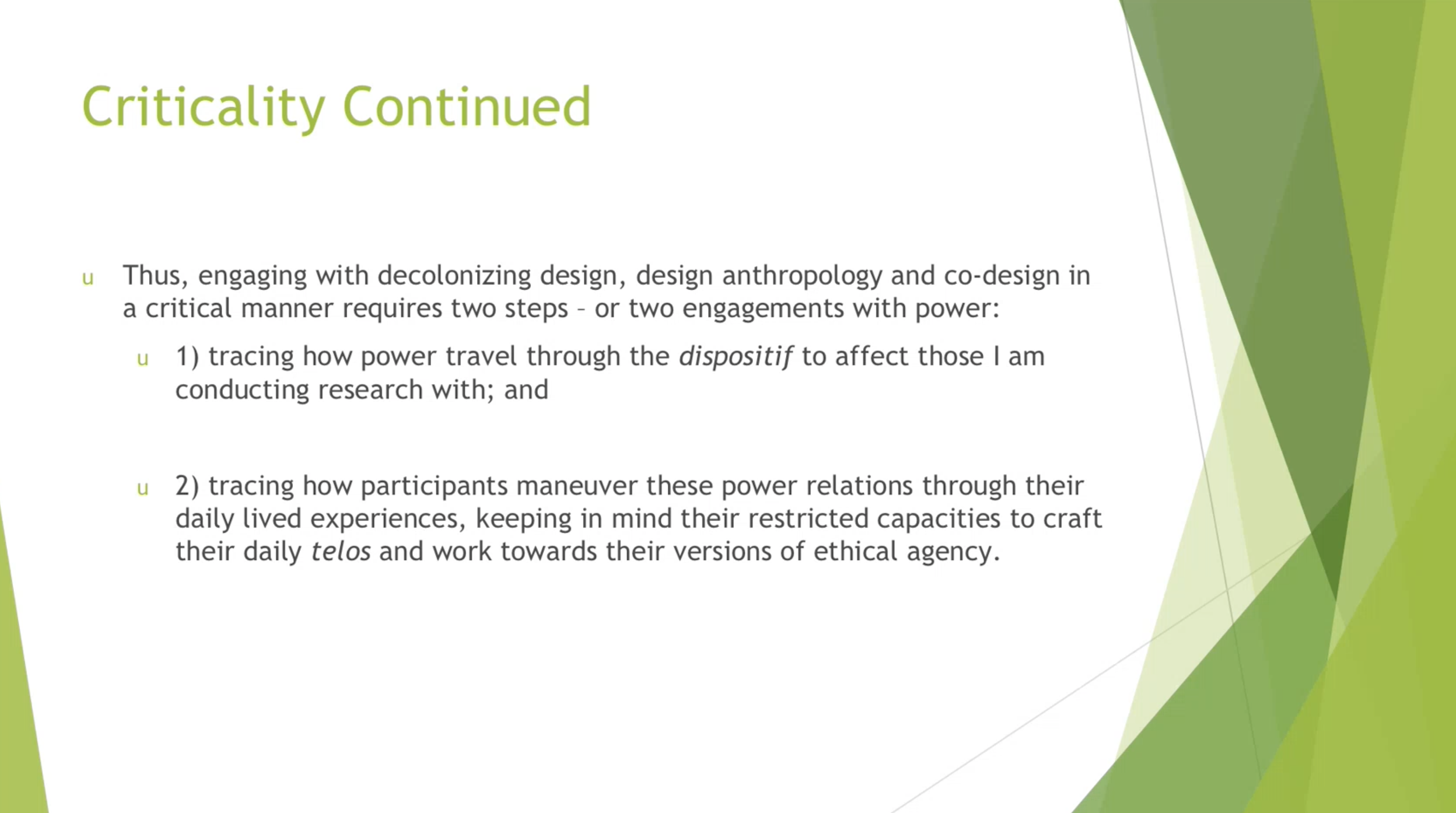
Criticality
Academic co-design must be different from commercial co-design to avoid the preservation of power structure from it.
Power travels through the disposifif (Foucault 1980), whereby an "ensemble' of practices, institutions, architectural arrangements, regulations, laws, administrative measures, scientific statements, philosophical propositions and morality" (Shore and Wright 2011:23) structure our everyday environments.
Research context must have the understadning of social, politial, econocmics, cultural elements of this environment. Without these elements, research study would be just theoretical and historical piece.

from Critical co-design process - low income older adults from social housing to long term care facility is not a desired outcome for themselves.
They also don't want to move to long term care facility partially due to high priced cost.
the first session, existing journey map.
Dr. Wyndham used 2 techniques - one, map ot the systems of power, two, map out of their experiences on top of the systems of power.
the second session, their wants and need: ideal journey. - physcial housing, community support, community based social activities, better transportations -> multi focused solutions.
also used 2 techiniques - one, institutions of structures and two, their journey
the thrid session was a result from those two.
two policy makers and service providers. (housging providers, social service agency) - asked feasible solutions from them.
2 techniques - mapping out existing policy environments and what needs to change so that people can navigate in that.
Critial co-design is formative process for both the researcher and the participants.
Critical co-design is hard to get funded becausse of the nature of uncertainty of outcomes.
People's lived experience as knowledge translation piece.
Photo voice example:
The participants(indegineus) were given ipad to capture photos of surroundings/ communties/ previous house they lived. That was his (the participant's narrative). The resiliency and insta bility example.
'DESIGN RESEARCH' 카테고리의 다른 글
| Knowledge Translation template (0) | 2021.11.19 |
|---|---|
| Tools to make progress in your research journey (0) | 2021.11.19 |
| Justifying your epistemological perspective (0) | 2021.11.15 |
| [Researcher's Standpoint] Older Adults 2 (0) | 2021.11.15 |
| Knowledge translation (0) | 2021.11.10 |
- Total
- Today
- Yesterday
- research questions
- previous education
- inclusive design
- corporeal
- health design research topic
- pico search
- Team Project
- healthy Ageing
- research topic exploration
- undergraduate studies
- mood board
- terminology
- Wearable Technology
- design research
- feels like today
- co-design
- health context and design
- grey literature
- essay writing
- diabetes
- design for health
- designprocess
- designforhealth
- self reflection
- Human Factors
- mental health
- researcher's standpoint
- designresearch
- research topic
- Reference