
티스토리 뷰
Interview with Dr. Bruce Perkins, Director, Leadership Sinai Centre for Diabetes and The Sam and Judy Pencer Family Chair in Diabetes Research
http://support.supportsinai.com/site/PageServer?pagename=DiabetesandEndlessPossibility
As diagnosed as a type 1 diabetes patient, Dr. Perkins shared his own experience as being a diabetes patient himself and led the study in diabetes care and research at Mount Sinai hospital. This is an inspiring story as the patient did not lose hope but decided to pursue the career path to study and research in that area.
Also from this article, I came to learn that insulin was discovered by Canadian doctors in 1921 and this year marks its 100th anniversary. (see below for that part)
In 1921, Frederick Banting, his student Charles Best and their team discovered insulin in a lab that stood just a stone’s throw from the current Sinai Health’s main hospital building. I owe my life to that discovery, and I am emotional in the realization that we are on the cusp of its 100th anniversary. Even more so, I am moved by the realization that I now work as part of a team that will advance and revolutionize diabetes research and clinical care for future generations.
In anticipation of the 100th anniversary, we embarked on a planning process to commit ourselves to leveraging and enhancing our top position in the discovery of new therapies for diabetes, and scaling-up the professional and patient education programs at which we excel. This will require support and expansion of our clinical, education and research teams to position ourselves to begin this next 100 years armed with even greater strategies to transform the lives of people with diabetes.
Extraction and purification[from wikipedia]
In October 1920, Canadian Frederick Banting concluded that the digestive secretions that Minkowski had originally studied were breaking down the islet secretion, thereby making it impossible to extract successfully. A surgeon by training, Banting knew that blockages of the pancreatic duct would lead most of the pancreas to atrophy, while leaving the islets of Langerhans intact. He reasoned that a relatively pure extract could be made from the islets once most of the rest of the pancreas was gone. He jotted a note to himself: "Ligate pancreatic ducts of the dog. Keep dogs alive till acini degenerate leaving islets. Try to isolate internal secretion of these and relieve glycosuria."[121][122]

Charles Best and Clark Noble ca. 1920
In the spring of 1921, Banting traveled to Toronto to explain his idea to J.J.R. Macleod, Professor of Physiology at the University of Toronto. Macleod was initially skeptical, since Banting had no background in research and was not familiar with the latest literature, but he agreed to provide lab space for Banting to test out his ideas. Macleod also arranged for two undergraduates to be Banting's lab assistants that summer, but Banting required only one lab assistant. Charles Best and Clark Noble flipped a coin; Best won the coin toss and took the first shift. This proved unfortunate for Noble, as Banting kept Best for the entire summer and eventually shared half his Nobel Prize money and credit for the discovery with Best.[123] On 30 July 1921, Banting and Best successfully isolated an extract ("isleton") from the islets of a duct-tied dog and injected it into a diabetic dog, finding that the extract reduced its blood sugar by 40% in 1 hour.[124][122]
Banting and Best presented their results to Macleod on his return to Toronto in the fall of 1921, but Macleod pointed out flaws with the experimental design, and suggested the experiments be repeated with more dogs and better equipment. He moved Banting and Best into a better laboratory and began paying Banting a salary from his research grants. Several weeks later, the second round of experiments was also a success, and Macleod helped publish their results privately in Toronto that November. Bottlenecked by the time-consuming task of duct-tying dogs and waiting several weeks to extract insulin, Banting hit upon the idea of extracting insulin from the fetal calf pancreas, which had not yet developed digestive glands. By December, they had also succeeded in extracting insulin from the adult cow pancreas. Macleod discontinued all other research in his laboratory to concentrate on the purification of insulin. He invited biochemist James Collip to help with this task, and the team felt ready for a clinical test within a month.[122]
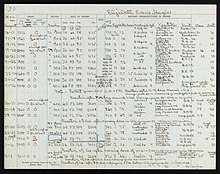
Chart for Elizabeth Hughes, used to track blood, urine, diet in grams, and dietary prescriptions in grams
On January 11, 1922, Leonard Thompson, a 14-year-old diabetic who lay dying at the Toronto General Hospital, was given the first injection of insulin.[125][126][127][128] However, the extract was so impure that Thompson suffered a severe allergic reaction, and further injections were cancelled. Over the next 12 days, Collip worked day and night to improve the ox-pancreas extract. A second dose was injected on January 23, completely eliminating the glycosuria that was typical of diabetes without causing any obvious side-effects. The first American patient was Elizabeth Hughes, the daughter of U.S. Secretary of State Charles Evans Hughes.[129][130] The first patient treated in the U.S. was future woodcut artist James D. Havens;[131] Dr. John Ralston Williams imported insulin from Toronto to Rochester, New York, to treat Havens.[132]
Banting and Best never worked well with Collip, regarding him as something of an interloper,[citation needed] and Collip left the project soon after. Over the spring of 1922, Best managed to improve his techniques to the point where large quantities of insulin could be extracted on demand, but the preparation remained impure. The drug firm Eli Lilly and Company had offered assistance not long after the first publications in 1921, and they took Lilly up on the offer in April. In November, Lilly's head chemist, George B. Walden discovered isoelectric precipitation and was able to produce large quantities of highly refined insulin. Shortly thereafter, insulin was offered for sale to the general public.
'DESIGN RESEARCH' 카테고리의 다른 글
| Questions to think about: Week 3 (0) | 2021.10.16 |
|---|---|
| What is researcher identity memo? (0) | 2021.10.15 |
| Questions to think about: week2 (0) | 2021.10.14 |
| [Researcher's Standpoint]Research Topic Exploration: Older Adults (0) | 2021.10.14 |
| Questions to think about: week1 (0) | 2021.10.14 |
- Total
- Today
- Yesterday
- researcher's standpoint
- research topic exploration
- healthy Ageing
- inclusive design
- Wearable Technology
- grey literature
- design research
- self reflection
- diabetes
- health context and design
- co-design
- Team Project
- mood board
- mental health
- feels like today
- designresearch
- design for health
- terminology
- research questions
- health design research topic
- previous education
- research topic
- designprocess
- Human Factors
- essay writing
- designforhealth
- corporeal
- pico search
- undergraduate studies
- Reference