
티스토리 뷰
[team project] Mental Health self care for Adolescent: Product Research
helen bae 2021. 10. 12. 00:51[Team Project] Mental Health self care for Adolescent: Product and Physical Environment Research
Phase two
In this stage, you should have your project defined and know your target users and stakeholders. This is the first time you introduce your group project to your cohort, so walk them through your discovery and definition stages.
- Describe how you have reached this point
- Introduce your users and how you are planning to address their needs
- Also, prepare a stakeholder analysis (remember: stakeholders are all who are involved, including end-users and their families, specialists, technologists, policymakers, financial supporters, etc.)
Explain the background of your work and existing studies as it will influence your design. What research method you are using, and what are your findings till this point. You should not have the end design or solution at this point.
Research on Mental health challenge issues for Youth
/p>
HOW MIGHT WE... facilitate self-care for adolescence (13-16 yrs old)?
General definition of mental health tool
- Connect with others (Socialization)
- Stay positive. (Motivation / Personal life strategy / lifestyle)
- Get physically active. (Exercise)
- Help others. (Socialization)
- Get enough sleep (Physical well-being)
- Create joy and satisfaction (Personal life strategy / lifestyle)
- Eat well ( Physical well-being)
- Take care of your spirit ( Personal life strategy/ lifestyle)
Source: (Mental health America) https://www.mhanational.org/ten-tools
Mental Health Kit for Youth
DIY or non profit products
Board game
Mental Health Bingo (self care edition)
YOUTH LEAD is an online network of young contributors making a different in their community. This online community is based in the United States and provide their local communities and provide webinar which cover divers target group in international level. Primary website contents are available in English, Spanish and French which covers racialize youth.
https://www.youthlead.org/resources/mental-health-kit-mental-health-bingo-self-care-edition
Self- soothe boxes (DIY kit)
https://www.youtube.com/watch?v=TTYlS3u3A_E
Simple tool kit idea that can be used by anyone and it is a self-kit and thus customized for themselves. The box can contain any items that would provide the comfort for themselves.
I designed a similar item when I was a student at OCAD and it was a kiss box. This kiss box had similar concept and could be any choice of objects.
Creative Journaling
Commercial products
Therapy Dough
Modeled after clay used by art therapists, this dough is infused with essential oils for stress relief.
Remember playing with dough as a kid? Squishing, squeezing, and shaping it into anything your heart—and imagination—desired. This grown-up version lets you relive that childhood fun, and provides adult benefits: stress relief and aromatherapy.
Created by Cammie and Kip Weeks, the colorful putty was inspired by the kind art therapists use to help patients manage depression, anxiety, and difficult emotions. (Clay play is also used occupational and physical therapy.) By adding essential oils, Cammie and Kip developed a dough that helps fight the fidgets, ease tension, and brighten your day. Choose from lavender for calm, peppermint to increase energy and awareness, or orange to improve mood. Handmade in Portland, Maine.
Self-care kit (Physical Hygiene)
Lululemon: Body cleansing kit
Saje (stress relieve aroma kit)
DIY- Etsy shop (one of examples)
Customized kit box contains doodling tools (coloured pencil, sketchbook), herbal teas, chocolate, etc
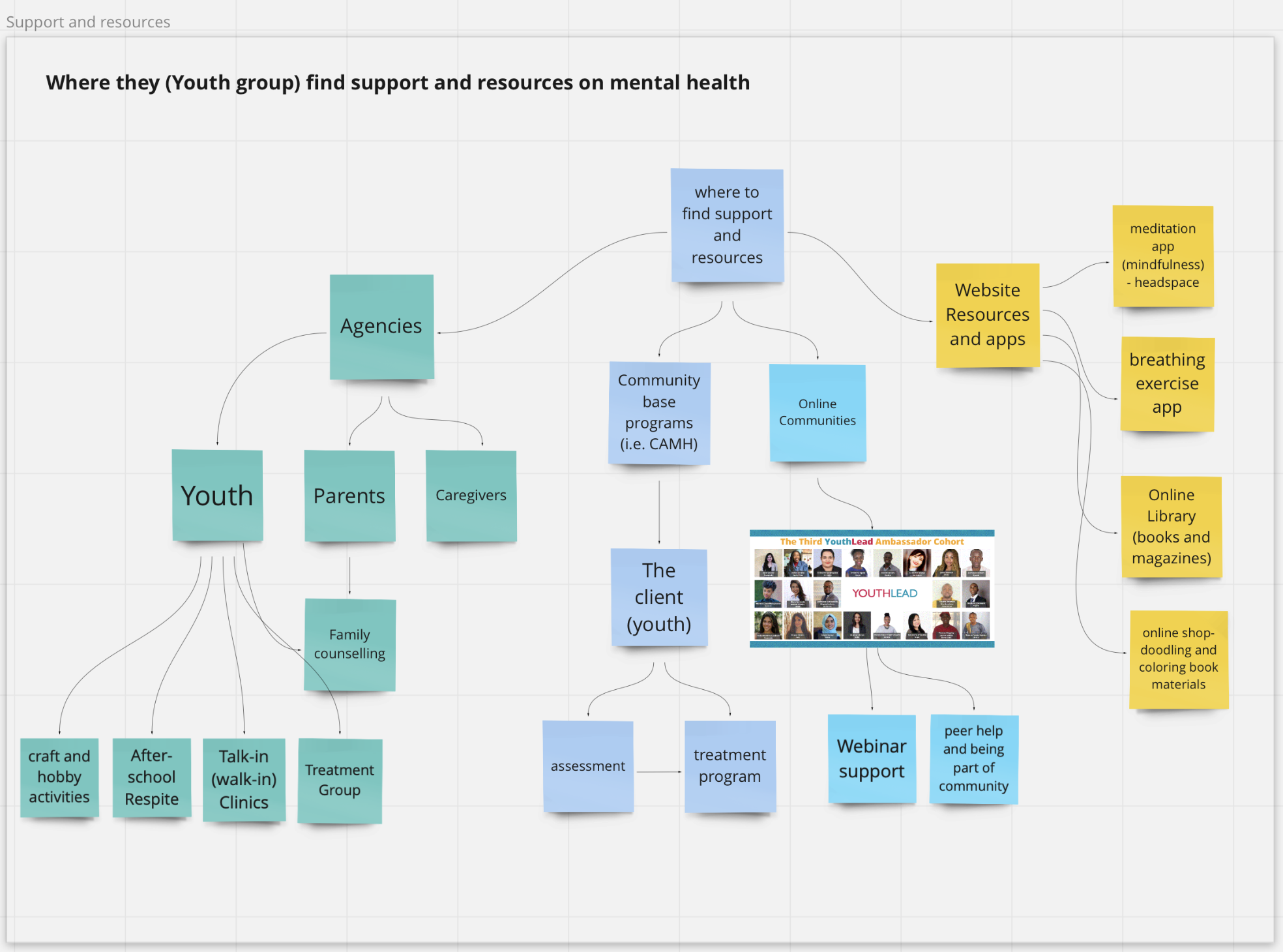
Agencies
Wellkin (Agency)
Oxford Child & Youth Centre officially opened its doors in October of 1987 and was initially located in just one location, on the corner of Dundas and Clarke Street in Woodstock, Ontario. We provided a wide range of services for infants, children and youth and their families, who resided within Oxford County.
Wellkin’s target groups are children ages from infants to teenagers, their parents, and caregivers who live in Ontario. They have programs and services which are include screening, assessment, treatment, and education.
The programs include treatment for the child and their parents, School community intervention partnership, Therapy services and Group workshops for the youth.
They have detailed online resources which contains useful website links and apps.
Mental Health Services (Local Communities)
Communities based programs offers specialized and treatment programs for Youth, their parents and care givers.
- CAMH (Centre for Addiction and Mental Health)
- Griffin Centre Mental Health Services (1126 Finch Ave. West)
- East Metro Youth Services (Scarborough)
- Lumenus Community Services (1126 Finch Ave. West)
CAMH Youth program
CAMH has treatment and services include assessment and group treatment. Intended for Children and youth aged 6–18 years (and their parents/caregivers) who are experiencing mood and/or anxiety difficulties.
https://www.camh.ca/en/your-care/programs-and-services/mood-anxiety-for-children-youth-service
https://www.camh.ca/en/your-care
Craigwood Children, Youth & Family Services
The programs include;
- Intensive family services including parent group services
- Youth and family Counselling
- Day treatment (section 23 school program)
- Youth Treatment Groups
- Talk-in (walk-in) Clinics
- After-school Respite
https://www.craigwood.ca/programs/community-based/
Online resources
Wellness Kits
https://wellkin.ca/wellness-kit/
Target group: parents and their children
Brief: This is online resource / hub that contains useful apps, website links that support mental health management for family (parents), kids and teens. This website also promotes Covid 19 mental health tool kit as well.
- Virtual Family Wellness Resources including various apps;
- breathing exercise mobile app (breathball.com)
- your covid-19 mental health tool kit (Pathstone mental health)
- mental wellness first aid kit (Lost + Found)
- Guided Meditation for teens
- Free Online Books for teens: free access to online books and reading resources
- Sensory DIY : Craft kit for play time and keeping calm down
- Journaling 101: Resources for kids to lean about mindfulness journaling, journaling apps, journal prompts
CHILD & YOUTH MENTAL HEALTH TOOLKITS
http://www.shared-care.ca/toolkits
Toronto District School Board (TDSB)
Mental Health and Welling-Being Resources links
https://www.tdsb.on.ca/School-Year-2021-22/Mental-Health-and-Well-Being
Physical Environment
Impact from the pandemic: Covid-19
SickKids-led study shows troubling impact of COVID-19 pandemic on child and youth mental health.
Over 70 per cent reported worse mental health during the initial COVID-19 lockdowns. This might look like feeling lonely, overwhelmed, sleepless, worried, sad, irritable, anxiety, stressed. Greater stress from isolation is the most significant risk factor for worse mental health.
The research team surveyed more than 1,000 parents of children and youth aged two to 18 years old, and nearly 350 youth between 10 and 18 years old, from April to June of 2020.
Across six domains of mental health – 1. depression 2. anxiety 3. irritability 4. attention span 5. hyperactivity 6. obsessions/compulsions
70.2 per cent of school-aged children (six to 18 years old) and 66.1 per cent of preschool-aged children (two to five years old) reported deterioration in at least one domain. A smaller proportion, 19.5 per cent of school-aged children and 31.5 per cent of preschool-aged children, reported improvement in at least one domain.
“We found that overall, children were faring mostly worse, and occasionally better, compared to their pre-pandemic selves,” says Dr. Daphne Korczak, Child and Adolescent Psychiatrist at SickKids and Principal Investigator of the study. “We also found that the mental health impacts of the pandemic were greater for school-aged children during the first lockdown, underscoring the importance of in-class learning and extracurricular activities for children.”
Responding to the Impacts of the Climate Crisis onChildren and Youth
Abstract
Climate change poses an urgent threat to future generations. Children are more susceptible to its effects than adults, with immediate and lifelong impacts on their physical and mental health.In addition to having direct experiences of climate impacts, children and youth respond psychologically in troubling ways to their awareness of the climate crisis. Children’s and youth’s needs for support vary across contexts. Climate impacts are generally greater in the developing world (despite the fact that people there are less responsible for causing the crisis), where capacity to prepare for and adapt to the effects is weaker. Hence, we need urgent action on both mitigating climate change and adapting to its impacts. In doing this work, we must acknowledge and build the agency and engagement of children and youth, which also builds resiliency and hope. Although many programs are encouraging, they fail to reach all children in need and are limited in terms of evaluation. Experts in child development can help fill these gaps. In the developed world, few studies address how to support young people in face of their feelings regarding climate change. Listening and providing opportunities for active engagement are among the ways adults can help young people cope, and build a sense of efficacy and a capacity to tackle the crisis and adapt to climate impacts. The upsurge in school strikes for climate action demonstrates young people’s deep concerns about their future and their determination to prevent a climate catastrophe. The climate change crisis raises questions about how professionals committed to the well-being of the next generation should respond—business as usual is no longer an option, and many valuable ways exist to help ensure that children can thrive on a livable planet.
Children are more susceptible to climate change than adults, with immediate and lifelong impact on their physical and mental health.
- Climate impacts are generally greater in the developing world.
- Examples of climate impacts are floods, hurricanes, wildfires, heat waves
- Climate change creates longer lasting changes (e.g. rising sea levels, drought, changed growing seasons for crops, whole areas becoming uninhabitable)
- The World Health Organization estimates that they will suffer more than 80% of the illnesses, injuries, anddeaths attributable to climate change (McMichael et al., 2004).
How Does Climate Change Affect Children and Youth?
Climate change is regarded as the biggest global health threat of the 21st century (Costello et al., 2009; Watts et al., 2017). Itdisrupts basic requirements for health—clean water, clean air,and adequate food—and exacerbates underlying social, eco-nomic, and ecological factors that cause illness and prematuredeath at all ages.
The impacts of climate change can be direct or indirect, immediate or delayed. Threats to children’s physical health have been well studied and include fatalities and injuries; heat-related illnesses; exposure to environmental toxins; infectious, gastrointestinal, and parasitic diseases that are more prevalent in warmer temperatures (Sheffield & Landrigan, 2010);
The psychological and mental health impacts of climate events have been less well-researched, but evidence from climate-related disasters shows that they can be equally devastating. (Examples: posttraumatic stress disorder (PTSD), depression and anxiety, sleep problems, cognitive deficits, and learning problems )
Dependency on adults on adults can lead to health and psychosocial consequences related to the impacts of climate change on parent’s well-being, family functioning, economic status
Supporting Children and Youth in the Developed World
Most young people in the developed world experiencing climate change but not educate properly about it. (Example: parents may be tempted to protect their children from knowledge of climate change, and wrong information from the media, etc).
Given the evidence that many children feel powerless and hopeless and not build their sense that this is combined efforts to make the improvement. This misconception will lead them growing up to irresponsible adults
'STUDIO1-CORPOREAL' 카테고리의 다른 글
| Wearable technologies - Embroidery machines (0) | 2021.10.13 |
|---|---|
| Free style Diabetes device information (0) | 2021.10.13 |
| In class 2x2 Exercise (0) | 2021.10.13 |
| Digital sketchbook size (0) | 2021.10.11 |
| What is Corporeal (0) | 2021.10.11 |
- Total
- Today
- Yesterday
- design for health
- designforhealth
- research questions
- undergraduate studies
- research topic exploration
- designresearch
- corporeal
- grey literature
- diabetes
- health design research topic
- mental health
- healthy Ageing
- designprocess
- mood board
- design research
- previous education
- inclusive design
- co-design
- Wearable Technology
- pico search
- Team Project
- researcher's standpoint
- Human Factors
- terminology
- Reference
- research topic
- self reflection
- health context and design
- essay writing
- feels like today